
What 5,218 professional decision-makers reveal about leadership


A cross-cultural analysis of brain dominance across 15 languages, 42 countries, and 33 professional categories - and what it reveals about the leaders who reach the top
Executive summary
McKinsey's analysis of 189,000 leaders across 81 organisations identified four behaviours that account for 89% of the difference between strong and weak leadership. Those four behaviours map cleanly onto three biological intelligence centres - Head, Heart, and Gut - documented in peer-reviewed neuroscience for over 30 years.
Drawing on 5,218 completed 3 Brains Dominance assessments collected between 2021 and April 2026 - across 15 languages, 42 countries, and 33 self-reported professional categories - this article presents five findings with direct implications for executive development, leadership selection, and coaching practice.
Finding 1. The Gut Brain is the rarest dominant brain in professional populations. Only 10.9% of professionals lead from instinct.
Finding 2. Profession predicts brain dominance. Coaches and therapists are Heart-dominant; scientists, engineers, and finance professionals are Head-dominant.
Finding 3. The McKinsey four behaviours map cleanly to three brains. Half of what predicts leadership effectiveness lives in the Heart.
Finding 4. The senior leadership profile is not what most assume. Heart is not the differentiator. The head softens at the top, the Gut activates, and the extreme analytical specialist disappears.
Finding 5. The strongest predictor of senior leadership is not high Head - it is the absence of low Gut.
The transition from middle management to senior leadership is not primarily about becoming more analytical or more emotionally intelligent. The data suggests something different - and more useful.
The higher the stakes, the less complete the information, and the faster you need to decide. That is not a leadership problem, it is the pivotal leadership condition.
The question is which system they trust when the data runs out nd decisiosn have to be made?
Our data suggests that the leaders who reach the top have, consciously or unconsciously, developed an answer to that question.
Not by thinking harder, nor by feeling more, but by learning to hear a signal that arrives before the analysis is finished.
1. The McKinsey Leadership finding, revisited
In their 2015 study published in McKinsey Quarterly, Feser, Mayol, and Srinivasan analysed leadership behaviours in 189,000 people across 81 organisations. They were searching for the patterns that distinguished organisations with strong leadership from those with less effective leadership.
From a wide range of behaviours studied, four accounted for approximately 89% of the variance between strong and weak leadership organisations:
Solving problems effectively. Gathering information, analysing situations, and basing decisions on sound reasoning.
Operating with a strong results orientation. Focusing on execution, productivity, and translating vision into outcomes.
Seeking different perspectives. Listening to viewpoints, observing trends, and considering the broader environment before deciding.
Supporting others. Sensing what people need, building trust, and helping others overcome challenges.
Most leadership literature treats these as a list of skills to develop independently. They are not. There are four observable expressions of three biological systems working in coordination, and that is the more useful frame for both executive development and selection.
2. The neuroscience underneath
For most of modern history, intelligence was assumed to live entirely in the cranial brain. That assumption is wrong, and has been wrong since at least the late 1990s.
Dr J. Andrew Armour's research at the Montreal Heart Institute, published in Neurocardiology (Oxford University Press, 1994), documented a complex intrinsic nervous system in the human heart containing approximately 40,000 sensory neurons. These neurons are capable of independent learning, memory, and decision-making, and they continuously communicate with the cranial brain via the vagus nerve and intrinsic cardiac neural pathways.
Dr Michael Gershon's work at Columbia University, published in The Second Brain (HarperCollins, 1998), documented an enteric nervous system in the gut containing more than 500 million neurons - more than the entire spinal cord. The enteric nervous system regulates not only digestion but also instinctive responses to threat, safety, and environmental change, operating largely independently of conscious cranial processing.
These three neural networks did not appear simultaneously in evolution. The Gut nervous system is the oldest, present in the earliest organisms. The Heart nervous system developed alongside the rise of social mammals, where group belonging became a survival requirement. The cranial neocortex, capable of abstract reasoning and time-shifted analysis, is the most recent.
Each system carries its own form of intelligence and its own evolutionary purpose:
The Gut Brain is concerned with survival, action, and resource acquisition. It operates in the present moment and reacts in milliseconds to perceived threat or opportunity. Its core question: Am I safe, and will this succeed?
The Heart Brain is concerned with belonging, connection, and emotional truth. It also operates in the present moment, reading relational signals through cardiac neural feedback. Its core question: am I accepted, and does this honour my values?
The Head Brain is concerned with prediction, structure, and cause-and-effect analysis. It is the only system that operates across time - remembering the past, planning the future. Its core question: Is this logical? What comes next?
Effective decision-making requires all three. When one system is dominant and the others are silent, the result is the recognisable pattern of stuck professionals: the analytical executive who cannot act. This empathic leader burns out, the driven achiever who damages relationships.
3. Mapping McKinsey to the three brains
When the four McKinsey behaviours are mapped onto the three biological systems, the alignment is precise:

Two of the four behaviours (50%) belong to the Heart Brain. One belongs to the Head. One belongs to the Gut. Most leadership development programmes - particularly MBA curricula - emphasise the Head and Gut behaviours: analytics, strategy, results, decisiveness. The two Heart behaviours, which together account for half of what predicts leadership effectiveness, are typically taught as soft skills, treated as secondary, or absent altogether.
Half of what makes leadership effective lives in the Heart. Most leadership training treats it as the optional half.
4. What 5,218 assessments reveal
Between 2021 and April 2026, 5,218 professionals completed the 3 Brains Dominance Test. Participants self-reported their professional category from a structured list. The dataset spans 15 languages and 42 countries, with English speakers representing approximately 75% of the sample, followed by Croatian, Turkish, Italian, and Norwegian respondents.
The test produces three scores summing to approximately 105, indicating relative dominance across Head, Heart, and Gut. A score of 35 in each brain would indicate perfect balance; in practice, only about 3% of respondents show such balance.
The global picture
Across all 5,218 respondents, Head and Heart are roughly evenly distributed at the population level. The Gut is dramatically underrepresented.

Only one in nine professionals leads from instinct. Cultural narratives celebrate the gut-led entrepreneur, the instinctive founder, the decisive leader who acts before analysing. The data does not support that narrative. In a sample heavily weighted toward business professionals, executives, coaches, and therapists, the Gut Brain is by far the least dominant of the three.
Profession predicts dominance
When profession is held constant, distinct patterns emerge. Analytical professions cluster on Head dominance. Helping professions cluster on Heart dominance. Senior leaders sit between the two with a more balanced profile.

Three patterns are immediately visible. Scientists, engineers, and finance professionals score 40.6–41.7 on Head - the highest in the dataset. Their Heart scores are correspondingly the lowest of any group. This is consistent with the demands of analytical work. Still, it is also the profile most at risk of the Head-led leadership trap McKinsey identifies: solving problems effectively without seeking different perspectives or supporting others.
Coaches, therapists, and health professionals are the only groups in the dataset where Heart exceeds Head. This finding has implications for the coach-client relationship: when a Heart-dominant coach works with a Head-dominant executive, the dominant frequency in the room is not shared. This may explain why some coaching engagements feel productive but produce little behavioural change - the conversation is happening in different brains.
The senior leadership profile sits between the analytical and helping clusters. To understand why that matters, the averages alone are not enough. The shape of the distribution is.
5. The hidden story in the distributions
Comparing 254 middle managers with 365 senior leaders, the average scores tell a modest story: Head down 1.8 points, Heart up 0.1 points, Gut up 1.7 points. None of these shifts looks dramatic on its own. But averages obscure what is actually happening at each level. The distributions tell a sharper story - and the three brains do not move in the same way.
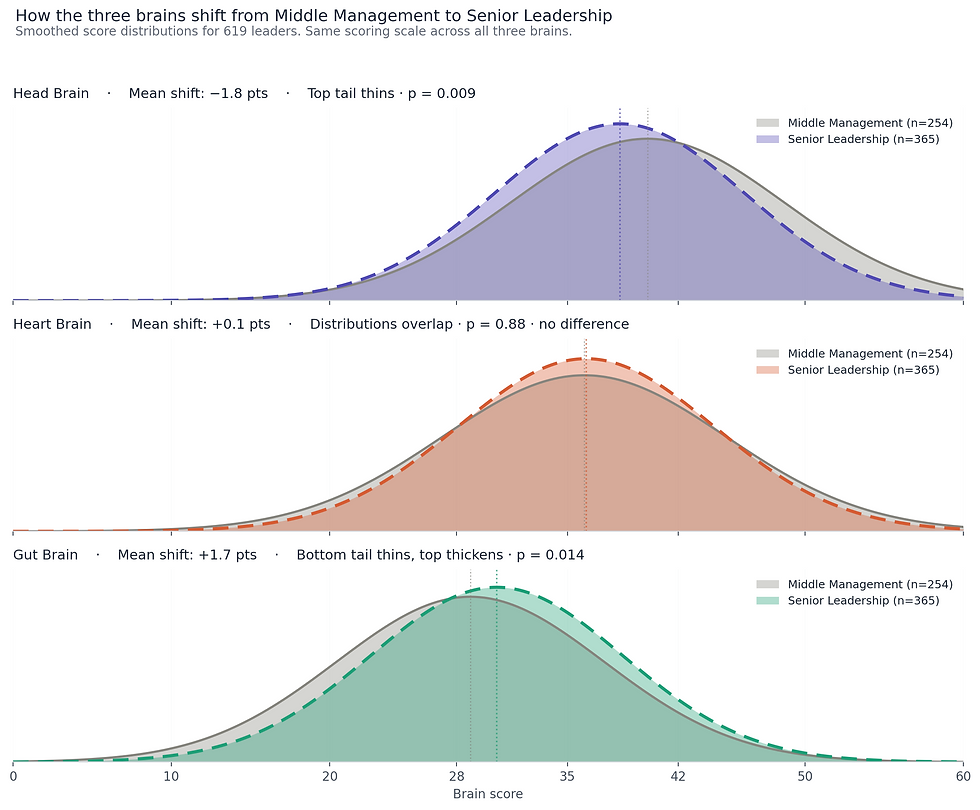
Smoothed score distributions for 619 leaders. Vertical dotted lines mark each group's mean.
Head Brain - the top tail collapses.
The proportion of senior leaders scoring 45 or higher on Head drops from 26.8% to 21.4% - a 5.4-point decline. Meanwhile, the mid-range (28–38) thickens by 5.2 points. In plain language: at the top of organisations, there are meaningfully fewer pure analytical specialists. The hyper-Head profile thins out as people rise. This is statistically significant (p = 0.009) and is the largest single distribution shift in the dataset.
The top of organisations is not where the most analytical thinkers go. Pure analytical excellence is the profile that thins out as people rise.
Heart Brain - almost no movement
The Heart curves are nearly identical between middle management and senior leadership. Means differ by 0.1 points. The bucket distributions barely move. The p-value is 0.88 - by any statistical standard, no difference.
This contradicts a substantial portion of the leadership development literature, which positions emotional intelligence as the differentiator for senior leadership. In this dataset, it is not. Heart Brain capability is roughly equally present at both levels. What changes from middle management to the top is the other two brains, not the Heart.
This does not mean Heart is unimportant - the McKinsey data shows that two of the four behaviours predicting leadership effectiveness require Heart engagement, and Heart capability is needed at both levels. But the data here suggests Heart is necessary for both middle management and senior leadership at similar levels. It is not what distinguishes the climb.
Gut Brain - the bottom tail thins
The Gut distribution shifts in the opposite direction to the Head. The proportion of senior leaders with very low Gut scores (under 28) drops from 42.1% to 35.3% - a 6.8-point decline. The mid-range and the high tail both thicken. The 90th percentile of Gut scores rises from 39 to 41. The proportion of Gut-dominant leaders rises from 12.2% to 15.9%.
This is the disappearance of a specific profile: the instinct-suppressed analytical performer. Either they don't get promoted, or they develop Gut activation as they rise - the data alone cannot distinguish. Still, the disappearance of that segment is real and statistically significant (p = 0.014).
Where the leaders actually are
Same distribution data shown as buckets.

Senior leaders cluster more in the mid and high ranges of Gut, less in the very high range of Head.
The dominant brain at each level

Head dominance drops from 55.1% to 47.9% - a 7.2-point shift. Heart dominance rises by 3.5 points. Gut dominance rises by 3.7 points. The Head-dominant majority shrinks; both other brains grow at roughly equal rates.
6. The integrated finding - what kind of leader emerges at the top
Putting all three brains together yields a sharper finding than the article would have from averages alone.
The senior leadership profile in this dataset is not more analytical than the middle management profile - it is less Head-extreme. It is not more emotionally intelligent than the middle management profile - Heart is roughly identical at both levels. What is meaningfully different is the disappearance of two specific patterns: the pure analytical specialist (very high Head) and the instinct-suppressed performer (very low Gut). What survives the climb is a more balanced profile.
The leaders at the top of organisations are not better thinkers than middle managers. They are leaders shaped by the disappearance of two extreme profiles - the hyper-analyst and the instinct-suppressed performer. What survives is balance.
This reframes the question of what leadership development should target. If the goal is to prepare middle managers for senior leadership, the analysis suggests the highest-leverage development is not 'become a better analyst' (Head is already strong) and not exclusively 'develop your emotional intelligence' (Heart is not the differentiator). The highest-leverage development is Gut activation - willingness to act under uncertainty, decisive presence, comfort with incomplete data.
7. Implications for executive development, HR, and coaching
For executive leaders
If you are a senior leader reading this, two findings are most relevant to you.
First, the progression from middle management to C-suite is not an analytical upgrade. The data points the other direction. Head activation declines slightly at the top. If you reached senior leadership through analytical excellence, that capability is now necessary but no longer sufficient - and continuing to sharpen it past the point of diminishing returns may actually distance you from the more balanced profile that characterises senior leadership.
Second, your Heart Brain capability is likely already present. The data suggests Heart capability is roughly equivalent at middle management and senior leadership levels. The practical question is not whether you have Heart capability - most senior leaders do. The question is whether your Heart Brain is consulted when decisions are made under pressure, or whether it is overridden by Head analysis and Gut urgency.
For HR and learning & development leaders
Three implications follow from the data.
First, leadership selection from the middle ranks is not predicted by the same profile as performance at the top. A high-Head performer in middle management is often promoted on the strength of that capability, then struggles in senior leadership where the extreme analytical profile is rarer. Selection criteria that reward only the strongest analytical performers will systematically underweight the candidates most likely to succeed at the next level.
Second, the strongest negative predictor for senior leadership success in this dataset is not low Head - it is low Gut. The bottom of the Gut distribution thins out at the top. A high-Head, low-Gut middle manager faces a structural ceiling. Development programmes that target Gut activation specifically - decisive action under uncertainty, physical presence, willingness to commit before full data - address the variable that most differentiates the two levels.
Third, leadership development that emphasises emotional intelligence as the senior leadership differentiator is targeting the wrong variable in this dataset. Heart capability matters - half of what McKinsey identifies as effective leadership requires it - but it is needed equally at both levels. It is not what changes between them.
For coaches and therapists
If you are a coach or therapist, you are highly likely to be Heart-dominant. Across 277 executive coaches and 71 life coaches in the dataset, Heart scores exceeded Head scores. Among 191 health and therapy professionals, the same pattern holds.
This has direct implications for client work.
When you coach a Head-dominant executive, your dominant frequency is Heart; theirs is Head. You are listening from a connection; they are processing from analysis. This is not a deficiency in either of you - it is a brain mismatch that requires conscious bridging. The client may report feeling heard but not changed. You may report deep sessions that produce no behavioural shift. Both experiences point to the same gap.
More importantly, the dataset suggests the development goal for high-potential middle managers seeking senior leadership is not primarily 'develop your emotional intelligence.' Heart is not the differentiator. The development goal is Gut activation. This is a different coaching conversation from the standard empathy-and-self-awareness track - and one that requires the coach to engage the client's instinctive system, not only their relational one.
Effective work across this gap requires speaking the client's dominant brain language first, then introducing the underdeveloped brains as the relationship deepens. A Head-dominant executive needs structured frameworks and clear cause-and-effect logic before they can engage emotional content. A high-Head, low-Gut middle manager needs grounded somatic work and decision-making practice before they can build the Gut activation that the data suggests differentiates senior leadership.
8. Methodology and limitations
The dataset analysed here consists of 5,218 completed assessments by self-selected participants who sought out the 3 Brains Dominance Test, primarily through the author's website, conferences, and coaching networks. This introduces selection bias: respondents skew toward professionals already interested in self-development, neuroscience, or coaching. The findings should be read as representative of professionally-engaged, self-aware populations rather than the general workforce.
Profession was self-reported from a structured list. The cross-profession comparisons reported here use only categories with n ≥ 70 unless otherwise noted. The leadership-level analysis (n = 619) combines middle management roles (Manager titles, Middle Management) and senior leadership roles (C-suite, Senior Director, Managing Director) into two comparable groups.
Statistical significance was tested using independent t-tests and Mann-Whitney U tests. The Head and Gut differences between middle management and senior leadership are significant at p < 0.05; the Heart difference is not.
The 3 Brains Dominance Test produces relative scores summing to approximately 105 across Head, Heart, and Gut. The instrument has been used in professional development contexts since 2010 and has internal consistency across the multilingual subsamples, but full psychometric validation against external criteria is ongoing.
Despite these limitations, the dataset is among the largest cross-cultural samples of professional brain dominance currently available, and the patterns reported are consistent across language subgroups and across the seven primary profession categories with n ≥ 100.
Conclusion
McKinsey identified four behaviours that predict 89% of leadership effectiveness. Neuroscience explains why those four behaviours and not others - they are the observable expressions of three biological intelligence systems working in coordination.
The data from 5,218 professional assessments confirm the framework's predictions and add one finding that the literature has not previously surfaced. Senior leaders are not more analytical than middle managers. They are not more emotionally intelligent than middle managers. They are leaders shaped by the disappearance of two extreme profiles - the hyper-analyst and the instinct-suppressed performer. What survives the climb is balance, not specialisation.
For executives, HR leaders, and coaches, the path forward is the same: stop developing one brain at a time. Develop the integration. The leaders who reach the top have already done it - usually without knowing what they were doing. The framework, the assessment, and the data make it possible to do it deliberately.
Take the free 5-minute 3 Brains Dominance Test at https://www.3brainsintelligence.com/3-brains-preference-test and see where you sit in the data.”
About the author. Christoffel Sneijders MCC is an ICF Master Certified Coach with 33 years of clinical and coaching practice, having worked with over 13,000 clients across 42 countries. He is the founder of the 3 Brains Intelligence Academy, a visiting professor in behavioural and organisational leadership at IE Business School (Madrid) and Georgetown University (Qatar), and the author of three books, including the forthcoming 3 Brains Intelligence: Forget Mindset and Discipline. The 3 Brains Coach Certification is accredited for 40 ICF CCEUs and 24 EMCC Professional Development Points.
Take the 3 Brains Dominance Test (free, 5 minutes, 16 languages): www.3brainsintelligence.com


Comments