
Gabor Mate: The myth of diagnosis in psychiatry, it’s simply a circular argument

Updated: Aug 17
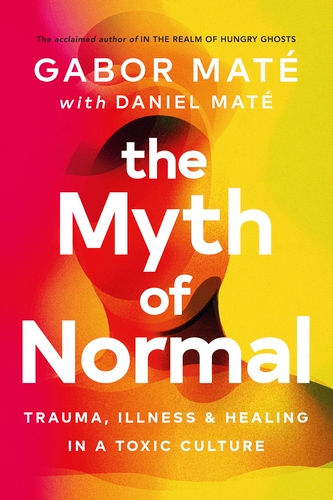
There is a passage in Gabor Maté's The Myth of Normal that I have gone back to more often than almost anything else I have read in the last few years, and it is not the part about trauma. It is the part about diagnosis.
When the diagnosis becomes the explanation
The dead end arrives, Maté argues, at the moment we start treating a diagnosis as though it were an explanation. In physical medicine, there is usually a way to check. There is a blood test, an enzyme level, a scan, something outside the description itself that can confirm it or rule it out. In psychiatry, as the British psychologist Lucy Johnstone put it to him, the reasoning tends to run in a circle. Why does this person have mood swings? Because they have bipolar disorder. How do we know they have bipolar disorder? Because they have mood swings.
The label describes the behaviour, and then the behaviour is explained by the label, and nothing new has actually been learned. Maté compares it to Pooh and Piglet walking round and round their own tracks in the snow, becoming more frightened of the Heffalump with every lap.
His objection is not that the categories are useless. It is that <cite>"diagnoses reveal nothing about the underlying events and dynamics"</cite> that produced the experience in the first place. They keep our attention on the effect and away from the cause.
The child born in December
The example that tends to stay with people is the one about birth months.
A University of British Columbia study looked at prescription records for almost a million schoolchildren over eleven years, and found that children born in December were around 39% more likely to be diagnosed with ADHD than their classmates born the previous January.
Nothing separates those children genetically. What separates them is that the December child entered the same classroom nearly a year younger, roughly eleven months behind in the development of the brain circuits that manage attention and self-regulation. They were not being medicated for a disorder. They were being medicated for being younger than the children sitting next to them.
Maté also makes the point, and it is worth sitting with, that despite decades of very well-funded searching, no single gene has been identified that causes mental illness. The researcher Jehannine Austin, who runs a genetic counselling clinic in Vancouver, told him that almost everybody carries some predisposing genes, and that what actually separates those who suffer from those who do not is what happens to them during their lives.
Why the genetic story is so comfortable
Maté offers one more observation, and this is the one I find most useful in a coaching room.
We are drawn to genetic explanations partly because they let us off the hook. If our patterns are written in our DNA, then nobody is responsible, not us, not our parents, not the culture that shaped us. Genetics arrives as a neutral, impersonal force of nature, and guilt quietly leaves the room with it.
Which is comfortable and also costly, because the same explanation that removes the blame also removes the possibility of change.
What I would add, from the other side
This is where I part company slightly, not with Maté, but with where the conversation usually stops.
If the diagnosis is not the explanation, then something else has to be. My own answer, after more than thirty years in practice, is that we have been looking for it in one place when there are three.
We do not decide with one brain. There is the brain power in our head, the one that thinks, predicts and reasons, and the one that talks. There is the heart, with its own network of some forty thousand neurons, occupied almost entirely with connection, belonging and what a change will cost us relationally. There is the gut, with its hundreds of millions, asking one question continuously, which is whether this is safe.
Read that way, several familiar labels start to look less like conditions and more like locations.
Depressed feeling often turns out to live in the heart, where a bond has been broken or a belonging has been lost. Anxiety often turns out to live in the gut, which has decided that something is not safe and cannot be talked out of it. And the endless analysis, the going over and over the same conversation at two in the morning, is usually the head running overtime trying to solve a problem in the past or the future, neither of which it can reach.
The number that surprised me in my own data
Across 5,575 completed 3 Brains assessments, in sixteen languages and forty-two countries, one pattern comes up more often than any other.
For 61% of people, the gut is the quietest of the three. Not the weakest, the quietest, the one scoring lowest of all. And only 17% of people come out anywhere near balanced across all three.
Which means that in roughly six people out of ten, the brain whose entire job is to work out whether it is safe to act is the one being listened to least. That is not a disorder, and it does not need a label. It is a system that has learned, usually a very long time ago and usually for good reasons, to turn one of its own voices down.
What can actually be done?
You might find it useful to stop asking what is wrong with me, which only ever returns a label, and instead ask which of my three has gone quiet and what it would need in order to be heard.
That question tends to open something. The first one tends to close it.
If you would like to see your own pattern, the free 3 Brains Preference Test takes a few minutes and gives you a language for what you have probably been sensing for years.
And if you are a coach, therapist or leader reading this, and you recognised your clients somewhere in the paragraphs above, the ones who understand their diagnosis perfectly and are no less stuck for understanding it, that gap is precisely what the 3 Brains Coach Certification is built to work with. It carries 40 ICF CCEUs and runs live online in small cohorts.

I would love to read your thoughts, and have a beautiful week.
Christoffel
Source:
Source: Gabor Maté with Daniel Maté, The Myth of Normal: Trauma, Illness and Healing in a Toxic Culture, 2022.



Comments